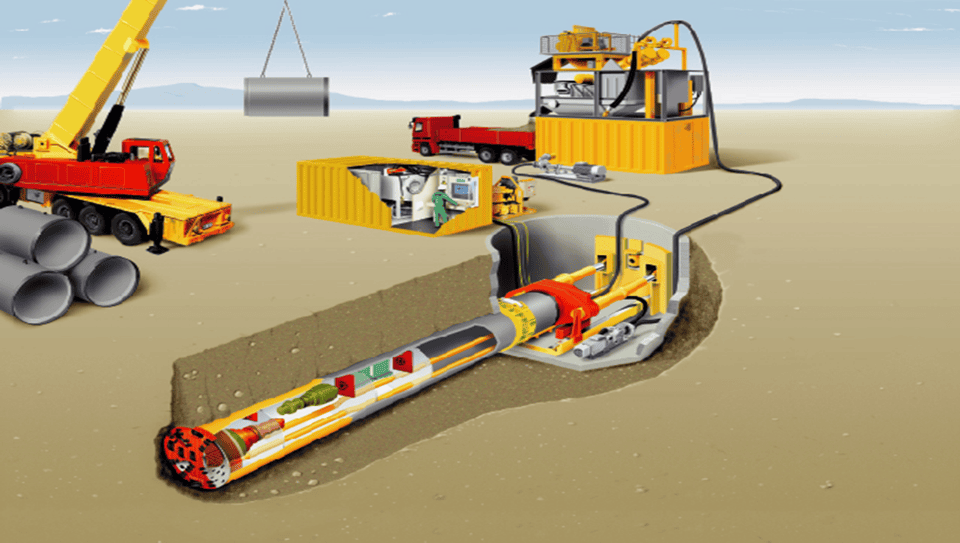
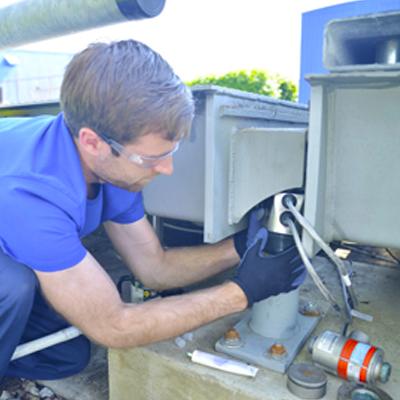
Pipe jacking is a technique of installing underground pipelines. High-capacity hydraulic jacks are used to push special tube burners into the ground with the front mounted locomotive.

- There are no technical limits regarding the length of each gland, but practical and economical issues can pose some limitations.
- The gland can be straight or curved with one or more different radius radii.
- The pipe jacking method is capable of supporting the soil and reduces the ability of the soil to move.
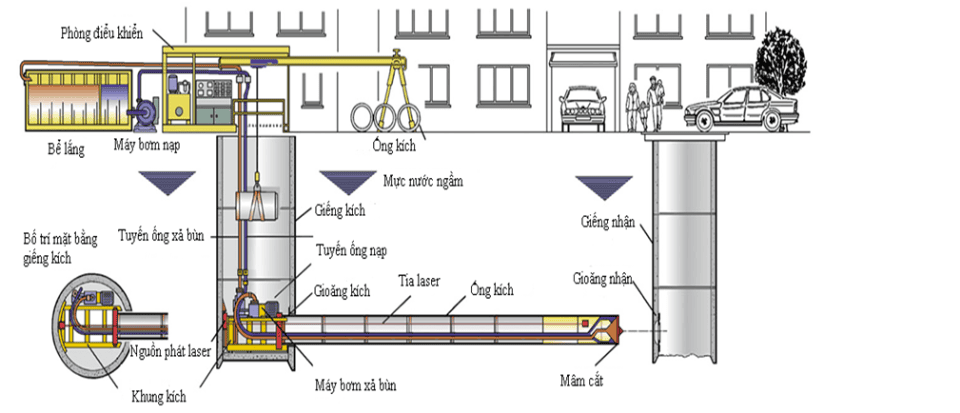
- Construction of underground drainage system by underground jacking technology is carried out through the following steps:
1. Surveying conditions and conditions of the ground before construction and measuring and determining the construction site.
2. Construction of jack and wells
- In Vietnam at present, jack and wells for construction of drainage systems can be constructed in two types:
The jack and wells received design calculations based on the results of existing geological surveys.
3. Accurately position the soft eye at the outlet of the jack and the entrance to the receiving well
- Soft eye positioning is based on the design elevation of the bottom of the drain.
4. Transporting construction equipment and culverts to the construction site
- The size of culverts is different from open culvert culverts to be suitable for pipe jacking work. There are 3 types of culverts:
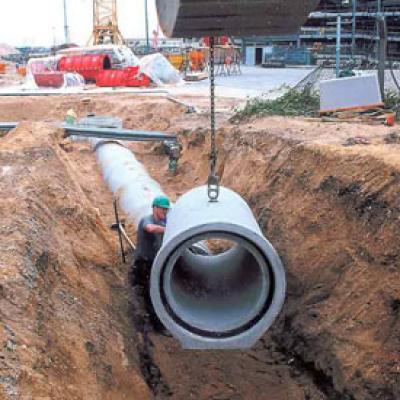
- Common sewer (Standard pipe): This sewer has a normal structure, only the hook position to lower the sewer into the jacking position.
- Bentonite grouting pipe (Grouting pipe): This drain has the same structure as a regular drain but has 3 more holes arranged 120oC apart by the circumference of the drain serving the lubrication of Bentonite grout around the wall.
- Intermediate pipe (Intermediate pipe): This is a pair of drain including male drain (Male pipe) and female (Female pipe). Intermediate jacks are arranged between the two sluice gates. After the complete jacking of the sewers, the intermediate jacks are dismantled and pushed together.
5. Installation of auxiliary equipment on the ground for raiding: Crane truck, sedimentation tank, dredger, generator, Bentonite pumping station.
- Bentonite pumping station aims to pump Bentonite mortar to the outside around pipe body to reduce friction force between soil and pipe wall.
6. Installation of auxiliary equipment in wells for jacking: mud pump system, ventilation system, control system, hydraulic system, electric system, bentonite pump system, guide system by lazer, water-proof seal, jet wall.
7. Installation of main jacking system and connection with auxiliary equipment: Hydraulic jack, push ring: contact ring between drain and main jack, drill head, intermediate jack (if any)
8. Operating jack system to bring drill head into the ground to start jacking work. Install follow-up culverts on the back of drill heads and intermediate jacking stations (if necessary) until they reach the receiving well.
- During the jacking process, the main jacking force should be monitored. If the main force is too large to break the drain, then the intermediate jacks need to be placed to reduce the main jack.
- The location of the intermediate jacking stations is determined based on the calculations.
9. At the position of the receiving well, installing the receiving gear, the jackhead receiving frame.
10. Transport drilling heads and jacking aids in tunnels out of receiving wells. Clear construction ground as prescribed.
- Application:
Main applications of jack jacking include construction of new drainage systems, replacement of sewers, main pipelines for water, gas, oil pipelines, installation of electric cables and telecommunication cables.
Special applications include the installation of a rectangular or circular tunnel tunnel for pedestrian and underground passageways.
Can be used to overcome obstacles such as highways, railways, canals, buildings and airfields in piping installation projects.
- Advantages
a. Technically:
- Can be constructed at different depths. Usually the economic depth to apply the jacking method is when the depth of pipe buried is ≥ 6m. At lower depths, jacking method is considered in relation to many other factors such as finance, environment, etc.
- Prevent the penetration of groundwater by sealing gaskets.
- Low risk of subsidence.
- Minimum disturbance on the ground.
- Minimize the volume of earthwork and reconstruction work.
- Less impact on other technical infrastructure.
b. Regarding the environment
- The environmental advantage comes from the application of jacking techniques when compared to traditional open-digging methods. Normally, with the no-digging method, the volume of "coming" and "going" materials will be reduced, along with the reduction of soil filling and ground leveling work.
- Table comparing the environmental aspects of the two methods of construction of open culverts and pipe jacks.

- In many cases, the use of jacking techniques instead of open excavation will have a positive impact on safety at the workplace, the lives of people around the construction site, and the local environment.